
“It Was a Start”: Andrew Petter on the Origin of the Galloping Goose & Lochside Trail
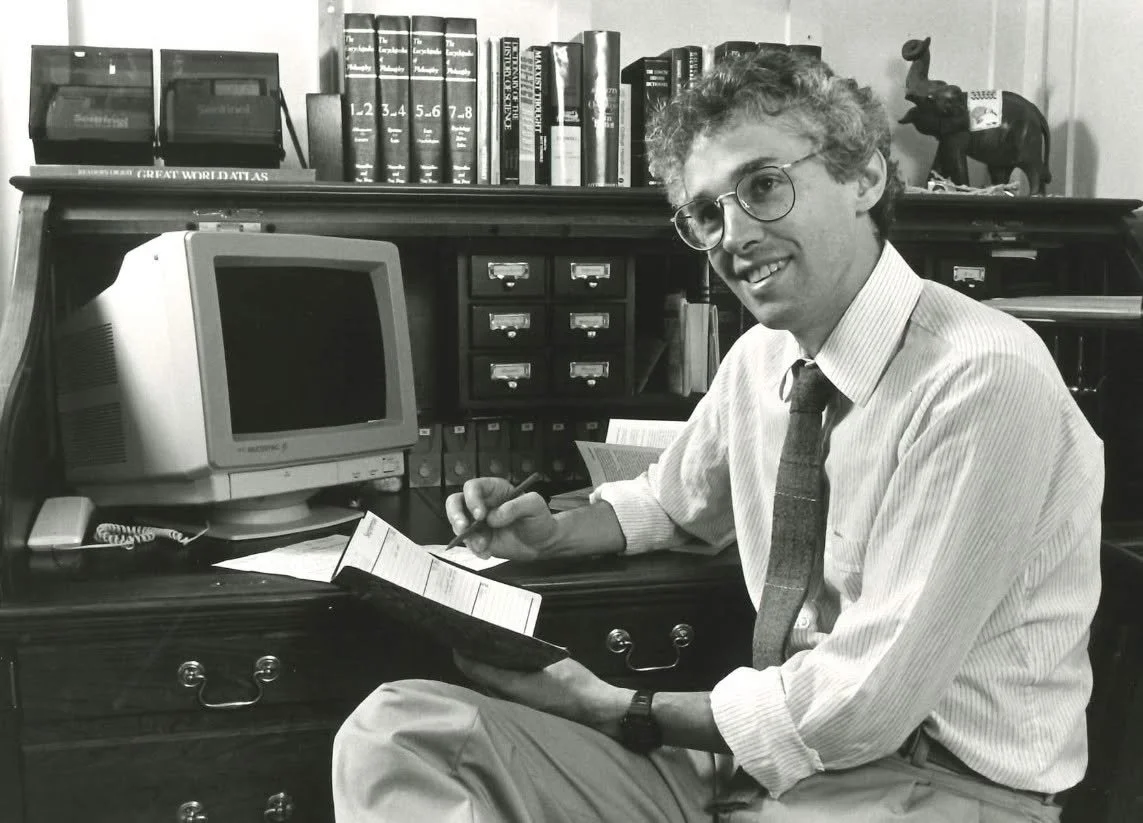
Andrew Petter, 1991 (SFU Archives)
The former MLA, cabinet minister, and head of the Provincial Cabinet Commission describes how the popular regional routes were created 30 years ago.
“In junior high, I lived in Nelson — a pretty hilly place. I had a mountain bike, and I'm sure I rode some trails, but I'm not an avid up-the-mountains and into the gorges kind of a cyclist. It isn't as if I came into government with a passion for this.”
My interest really came about when I was in government. I went through a lot of portfolios over ten years, but the one area of responsibility I kept for my entire time in cabinet was Provincial Capital Commission. Its jurisdiction was region-wide, so there was a natural pull to look at the region as a capital region in the same way that the National Capital Commission in Ottawa does, and to think of it in a way that transcended municipal boundaries.
I had the responsibility to promote a greenways strategy; I could look at infrastructure in a way that was more holistic than would be the case if there hadn't been an instrument like the Provincial Capital Commission. I could also provide grants and funding support to make things happen.
The Lochside Trail ran right through my constituency, right next to the house I was living in. There were people around me, advocates—some within government and some outside of government—who raised my awareness, and helped me to map out a plan to make a change. I happened to be in a particular place where I could do something about it.
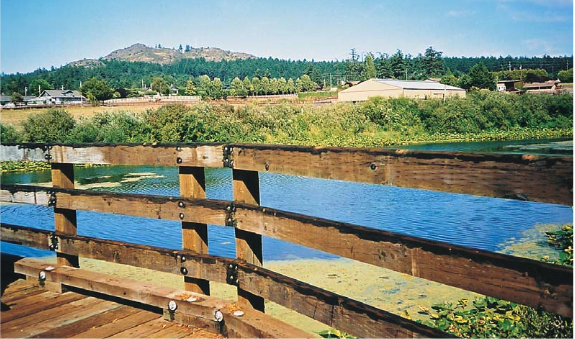
A lot of the trestles in downtown Victoria, which were key linkages in the trail system, were in serious decline, like the Selkirk Trestle, which was a link to Esquimalt and the west side. Areas of the rail right of way were being viewed as sort of dumping grounds. I remember Cecelia Ravine was the first section we did. That was just a matter of cleaning out a small section of trail so kids could use it for recreational cycling and roller-blading and that kind of thing. That was the start. That was the section where a municipal official said, "This is great Andrew, but why are you bothering? What difference is this going to make, bringing back this small section of trail?"
And of course that small section of trail by itself didn't mean a heck of a lot, it was actually for the neighbourhood. It did provide a recreation corridor for kids.
“But it was a start, a segment-by-segment return of the trail, of the trestles linking them up.”
And every time we did a linkage or we found an overpass over a highway, of course the potential for use and connectivity became greater, the benefit became exponentially that much larger. And then it took off from there.
There was a section out by Quadra and Mackenzie that had been turned over for use by a private landowner company. As you know, all it takes is one gap, one obstruction in a corridor like that, to compromise its entire potential as a transportation route. Thankfully we were able to negotiate that right of way back, and it's now part of the Lochside Trail.
Initially it just seemed like a really nice way of creating what seemed to be largely recreational corridors, because they weren't all connected up in a way that facilitated their use as thoroughfare commuter routes for cyclists, pedestrians, rollerbladers, all sorts of users. But as we started to get the pieces together—when we started to look at it as a system rather than just as a section of trail that could be restored here, or "wouldn't it be nice to restore the trestle" there.
“It started to emerge that there was huge potential to provide a significant transportation corridor for commuters to use in a more regular and work-related basis.”
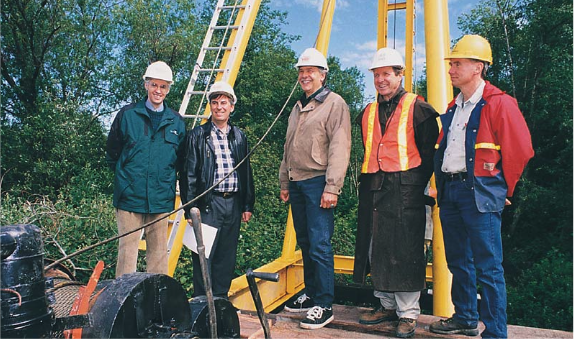
Key participants in the development and construction of Blenkinsop Lake Bridge, ca. 2000: Andrew Petter (MLA Saanich South), Frank Leonard (Mayor of Saanich), David Cubberley (Saanich Councillor), Chris Pease (Director of Saanich Parks and Public Works), Bob White (Surespan Construction Ltd.).
Municipal officials who questioned why we were doing it in the first place suddenly realized the huge potential that it had, and started getting on-board. Certainly by the time we got to the section of trail across Blenkinsop Lake, for example, it really brought that home, because it linked up the whole Lochside corridor out to Swartz Bay, to what had come together as the Galloping Goose. So it was a growing awareness on my part, but even moreso on the community's part, about just what a precious resource this was, and just by virtue of not understanding that, how close we came to losing it. What seemed to be small compromises could have had huge and devastating consequences.
The trestles are beautiful. They're just gorgeous. The Selkirk Trestle being brought back had both a heritage aspect to it, as well as a new means of transportation. It connected two communities that were not previously connected—certainly not by active transportation—in a way that created new meaning.
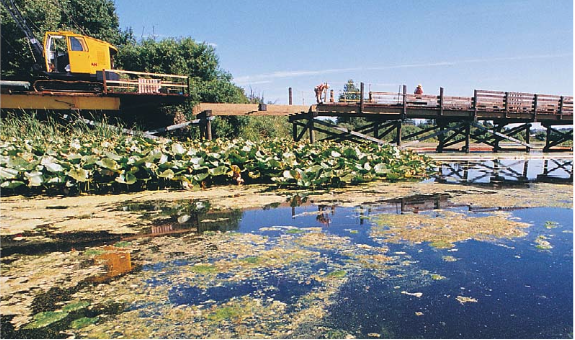
When the Blenkinsop Trestle went across Blenkinsop Lake, that was just extraordinary. That was a community-wide celebration. Thousands came out for it, I think because it spoke to both history and to a more sustainable approach to transportation. It brought so many different pieces together.
The other thing that happened around this time was the emergence of Bike to Work Week, which coincided with some of the trail development, and started to get people thinking of the trail system as a commuter system and not just in the recreation system.
So there was a growing awareness, and I think as people started to see how these pieces of trail connected, and as the cycling community itself drew more attention to it, and then the general public became more aware, there was a kind of growing momentum around this, in the sense that this was something of real value.
“It became a point of community pride that we were developing this system.”
All these different kinds of groups came together and coalesced, and saw the trail systems as symbolizing development that they wanted to embrace and support. People who saw them from a purely aesthetic point of view. People who saw the network as speaking to a larger agenda regarding climate change and shifting from a carbon economy. It was really quite exciting.
Even to this day, when I go back to Victoria I'm very appreciative of this. I was in government for ten years, I did a lot of things, the thing I'm most often people come up and talk to me about is the Galloping Goose and the Lochside trails.
One thing that made the development of the trail system easier was that it took place on a rail right of way that was not being used for any other purpose. So bringing it back as a pedestrian and cycling corridor didn't give rise to conflicts with motorists and other potential users in the same way that re-designating portions of the road system have caused some degree of conflict and tension within Greater Vancouver, for example. And wherever there's conflict between different users obviously, there's an opportunity for politics to assert itself on the seam of that conflict. And it becomes a more contentious issue.
So I guess one of the benefits—or maybe one of the privileges—of having the opportunity I had was that it wasn't zero sum. The re-designation of a portion of a roadway for cyclists might be seen as a zero sum proposition, as opposed to what it probably is, which is a positive sum proposition in terms of trying to improve transportation for everyone.
But in the case of the Lochside and Galloping Goose trail, while there were some areas where we had to navigate across or under highways—or even a section of the trail where we had to bring it back from a designation that it had actually been given for private use—by and large we were bringing something that was under-utilized into a state where it was being more utilized and more appreciated without displacing anyone. Therefore those kinds of political tensions and opportunities for scoring political points didn't arise.
David Cubberley was a driving force. David came into my office as an assistant and was very active in the cycling community in Victoria, and went on to become a Saanich councillor later. He could tell you chapter and verse about the respective roles played by the Provincial Capital Commissions in terms of funding the sections of the trail, the engineering work done by the municipalities, and in some cases by the Ministry of Transportation and Highways because we were talking about overpasses—integrating bicycle infrastructure into highway development.
John Luton who was also involved in government and was a very strong advocate and supporter, as was Alan Perry of CFAX radio who dubbed me as Minister of Rails and Trails at one point.
“I became educated around cycling as both a commuter option and a recreational opportunity.”
I also became motivated and mobilized—about how precious these linear corridors are, and how dangerous it was that they were being looked at in ways that could have compromised their future use.
Later on, I said to David Cubberly, "You know David, when I said you could work on this off the side of your desk, I hadn't intended it to be the top side." He deserves a lot of credit. He educated me. It was important that I was there to provide the support, and to make key decisions, but without David and without the Provincial Capital Commission and the Greater Victoria Cycling Coalition—without community support, without and the leadership there—it wouldn't have happened.
So I got on the bike with everyone else - the multi-tandem bike with thousands of people on it.”
From a telephone interview with Andrew Petter, former Member of the British Columbia Legislative Assembly representing Saanich South (1991-2001), on March 8, 2018.