"It's Going to be Good History": Why Elder Ruth Won't Give Up on The Great Blue Heron Way
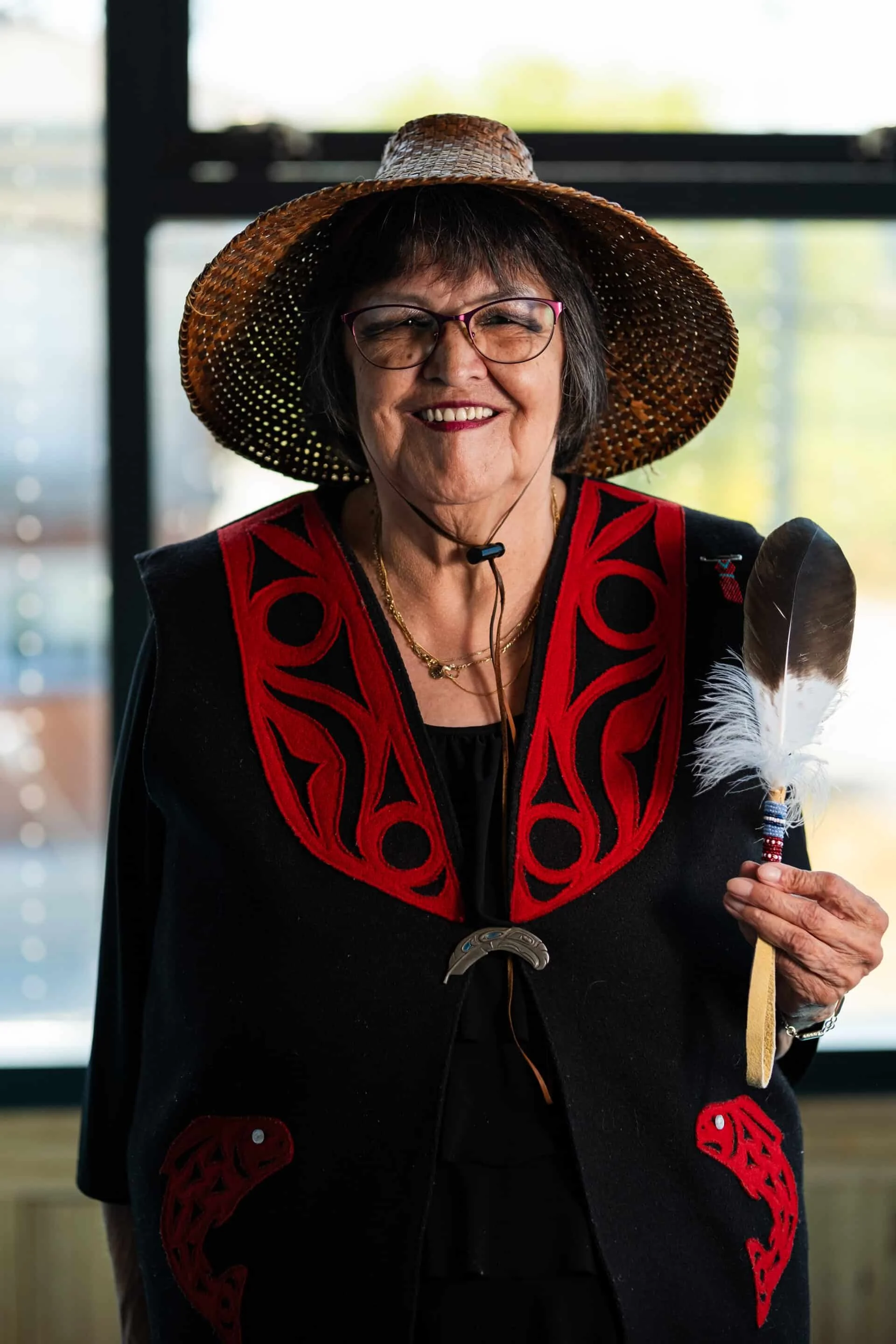
Elder Ruth Adams of Tsawwassen First Nation.
Elder Ruth Adams of Tsawwassen First Nation tells how 2009 treaty negotiations led to her vision for reconciliation through active transportation, and collaborating with others to honour the land we share.
“We don't get any recognition and acknowledgement for who we are as a people and what we've contributed to Canada. No-one's ever asked.”
My aboriginal name, xʷasteniya (‘Kostanya’), comes from around Nanaimo from my grandmother's side, my mother's parents. This is my mother's nation. I was born in Vancouver, and then moved all over the place. My history is quite wide.
I came back here with my grandparents in the summertime. I swam that beach when I was little. And I was feeling those were my happiest days, and I'm still happy, because I brought all my children here to live on this land.
I was at the age where we had the gate. My grandparents lived right at the highway where there was a fence with the only opening was to come onto the nation, with a gate that you had to be asking to go in and out of. So we were in jail, and I couldn't understand that. I didn't see that gate anywhere else. And I wondered why. So this started me to wonder why we were so different, and why we were treated so different. So I had all of that in the back of my head. I guess I've always had to know.
I'm one of those First Nations people that has always been an old person in my thinking. When I started to hear about the residential schools, my father and mother didn't talk about it, no-one ever talked about it, it was a horrible, horrible thing. So when I was off the nation and in the public, I was always trying to learn what happened. I'm always digging for information, all the time. That's what has always driven me.
“As First Nations people, we're really close to the land and everything that lives on it.”
So when we finished our treaty in 2009, it was important to me. I wanted people to know who we were and what we were about with the land. I thought that no-one really understands that they should be honoured to be walking on different parts of the land, even if they don't have anything, or don't own a house. Even if you don't own a house on the land, you're walking on it, and you're going to school on it, you're doing everything on that land, and it doesn't seem like ordinary people know that they should be honoured to be walking on the land.
When we did our treaty, they said well you don't have anything left, and I said we do. And I said nothing is going to be built on this part because this is where all of the birds come. And this is our nature, it's just like Delta and the walk. This is ours. And the Great Blue Herons. And the eagles. And everything else that comes here.
This is where my friend Carol Vignale comes in. When we were doing the treaty, we took a trip to Victoria to go and watch in Parliament. And they were talking about the Galloping Goose. And I asked them which First Nations are involved in the Galloping Goose. And so of course there were none. And the Galloping Goose goes right around the First Nations.
“So that's when I said, ‘We'll have the Great Blue Heron Way.’”
I still think it's a great idea, and I've worked on it for a long time. We're the first urban treaty of all the First Nations to lay the tracks down at least and say where this vision came from and why it came about. All of our children and most of the grown-ups here ride bicycles.
And Carol was the one that introduced me to HUB. When I started to go with HUB, I felt like, oh this is the place. Because of the bicycle riding and the land. I thought these are the people that I needed to be with, because they love the land too. And being on a bicycle instead of a car - because I use a car too, I drive. It's not that I'm against cars, but I thought these are the people who understand the beauty of the land and nature.
You have to understand that when we did our treaty, Delta was against the treaty and Gordon Campbell when he was in was against the treaty. So I and Carol would be going to these places to try to say, oh you're all wrong. We need to make a treaty. We need to get together. So the treaty for me, as an elder, is about getting to know the neighbours. It wasn't about separating, because we've been separated, the government's kept us divided. And I thought we'll have our treaty and we can get to know our neighbours.
Carol was the one little individual from Delta who supported us and what we were doing. We connected and kept on working from then on.
Working with HUB is one of those things that heal me, because it gives me hope of reconciliation. HUB was very respectful to me on my journey. So I felt like this is where I need to be, even if I'm not a long time bicycle rider. I just believed in what HUB was doing. And also being in Vancouver, seeing everybody riding their bicycles on the busy streets and that, Carol and I both thought that was a wonderful idea. And I still think it's so good that people will not be in their cars, that they would be able to ride safely on their bicycles to go to work.
“I've never given up.”
Sometimes it was hard because even for our nation there were people who said, oh no we've got enough people around us right now. Why are you going to bring all those bicyclists in? What, I said, I've never seen more than twenty bicycles at a time. Everybody comes through and there's six at a time or whatever.
It's just fear. People fear change, and you can read that in the papers - oh no, look at this the bicycles are taking over. And I'm thinking, wow, that's good, because we've got generations to come. You've got to be out in the fresh air, enjoying the nature wherever you are, city of wherever.
For me, this is a path of reconciliation. And it will take time for everyone to get on board. But someone has to make a start, and that's what I think I'm doing. Other nations too, bringing them out of their shells.
“I always wonder, ‘Who do I think I am?’”
Because somebody said that to me - who do you think you are? Why don't you look after your own family? Because I've got four daughters, 18 grandchildren, and fourteen great grandchildren. Why are you doing this? I'm doing that for them, so that they will have a place. And so that they will know that someone cared to do this work. It took me a long time to get to that point, even with all of the committee members. But they are as intensive as I am to do this. So like I said, the important part for me is we started it.
I've been on the treaty ever since it began, and I also sat on the Delta treaty table. And I'm having to sell this idea of the Great Blue Heron Way to my own nation, and to the other nations - that we won't be joining them, everyone will be joining us.
Its footprints, its path is already made. So I'm thinking now it's time that the members know, in case something happens and everything comes together at once, and they won't know how it happened, I've got to tell my story, and I've got to let them know this is what's happening.
It's timing. Since I've been trying to make good neighbours in Delta, I went to all the committee meetings and did all that volunteer work, being involved with them. It's the preparation work, this is all preparation. And you need to do that. But when i say this is the time, I'm very much about the nature, and the climate change, and all of those things that are involved with today. We're working with Delta - it's slowly working, because they had such a big fight over the treaty. But it's slowly coming together I think.
“I've always had hope.”
I've always been driven by hope. I know we don't have to stay this way, but we have to work at it to change it. That means a lot to me.
We do have progress with the little parts of nature. Like the Great Blue Heron Way, and bicycles—it’s important to save that little part that we have, that we can go to the Fraser River, that we can go to the ocean, and that we can save those parts for ourselves, even though everything around us is progressing. That we can save that part. It's about saving that little part that we have left, and being together.
It puts a lot on bicycles, and it puts a lot on First Nations, but that is the way it has to be. We can't just leave things. And this is in the news and everything now too. You can't just leave it. You can't leave the racism and just let it go. So we always have to have something there that tells the reason why, and that we are together. Because we all ride bicycles.
The Fraser River to us is sacred. That ocean is sacred. And you say, well how can you say that, look at that the port and the ferry. Well, even with that there, you still got something left, and you have to save it.
This means a lot to me. Because it is an opening. It's an opening and it's something we can all work on, and have fun with. It's work but you can have fun.
“I think it is all about change.”
People are very afraid of change because to stay in a system, even if it's a bad system—people are afraid of change, even if it's a good change, it's more comfortable when you know how things are going to go, even if it doesn't go right for you, you're still comfortable because you know what's going to happen. When there's a change, people don't understand how that's going to go, and how they fit in.
"But Ruth, why would we need the Great Blue Heron Way? What are we going to get out of it?!?" There are some members that understand, but for me the ones that understand are the next generation. So that's why I keep going back to my great grandchildren.
For me it's getting our culture in the education system, because there wasn't much information given about us. I think that's where we start, with the children - letting them know that you can do this, and if you don't do this, you'll lose it. You will lose it.
As an elder, I don't want to lose anything. I want to work towards that and it is a little hard. And this is life, some things are hard. But to teach the children on what's good about it, and even go further to say, well why would we care about parts of nature that we want to save. Who's going to do that? Are you going to get in your car to save this nature? You're not going to get there with your car. You're going to get there by bicycle.
I think in the municipalities and in the big cities that bicycles have to go through the same system that I'm going through here in my community. It is no different, that's where we're the same. Showing them, and maybe taking children on bicycles and showing them the safe places. Teach them that. You can travel safely, but you can't travel safely unless you see it and want to try it.
“You've got to make them feel good about trying.”
You've got to show them. I think the older people are too set in their ways. They're too set in their ways and it doesn't matter to them. But I keep coming back to the humanity of this. Of teaching the children to cycle, going for change. Because we fight for our sidewalks, and that road down here. They say, nobody's going to be going down there. And I say yes, our own people with their cars, they're still going to be going down there. We want a sidewalk. So it's the same with bicycles. You're sure not taking away anything from those big cars. Bicycles won't take away from what's there, we just want to share what's left. Sharing what's left and holding onto it.
We can't do these things instantly, we have to work at it. Sometimes you have to wait for something to happen before you can address it. And when you get those doors opening where you can go in and address it, you have to go in. I'm very hopeful.
Our longhouse was torn down and the little church at the same time so we've really got history here. Because of the highway. We've got so much history. That's the reason why I do this is because we've got so much negative history. With the Great Blue Heron Way we could go to Parliament in Victoria, like we did with our treaty. That would be such a nice vision. For me anyways, it would be. And that's what I'm all about, I'm always about - I can see good things, and I try to work my way to make it happen.
I think my Great Blue Heron Way is going to be good history. We need something good. I've got so many good people working with me. It keeps me going when I've got other negative work going on.
I always see the other side of things. It was negative, but it doesn't have to stay that way.
From an interview with Elder Ruth Adams on August 18, 2017.
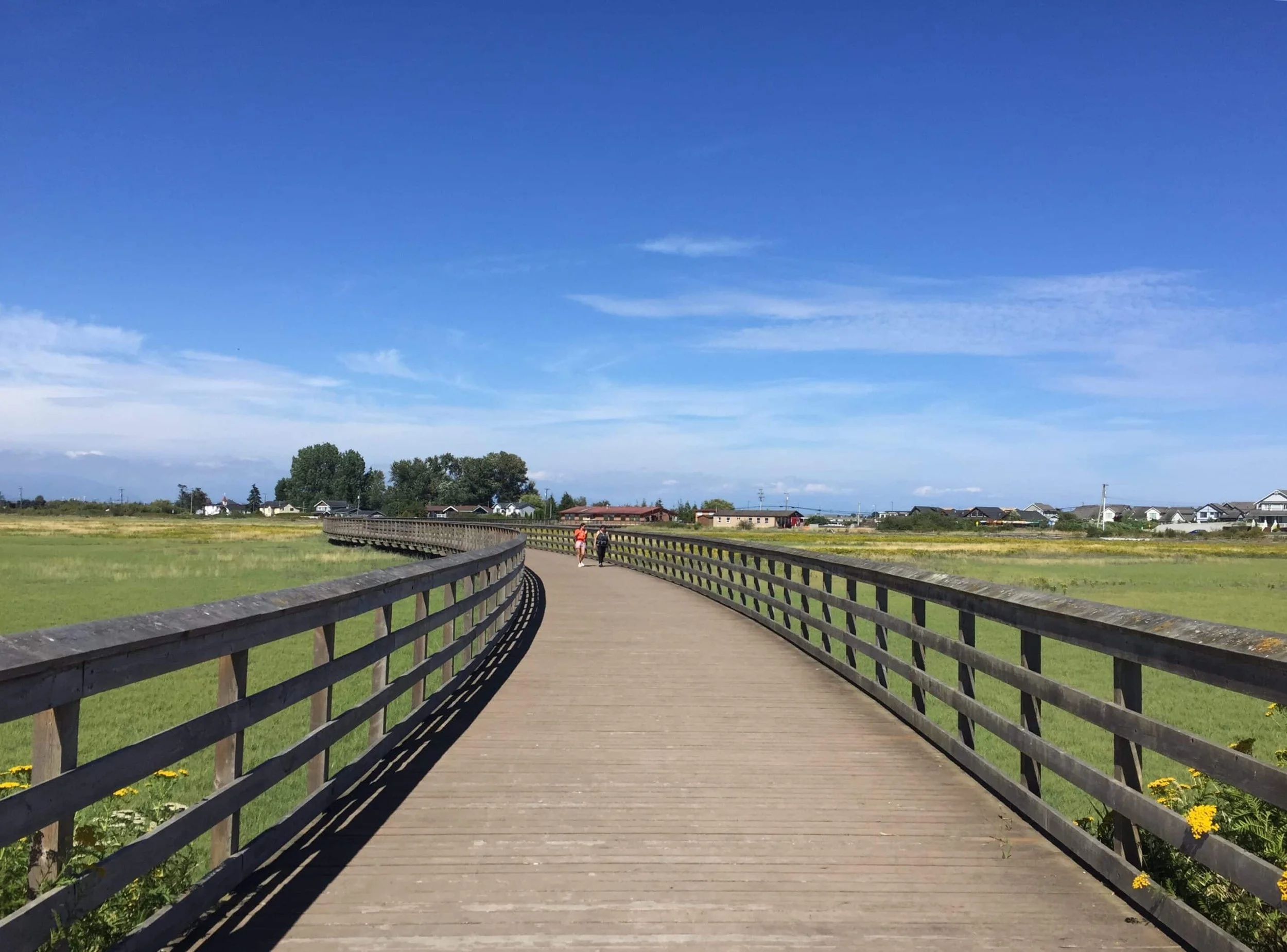
Photo courtesy of Trails Society of BC.