
“Power and change only comes when you do political organizing”: Olivia Chow Would Know
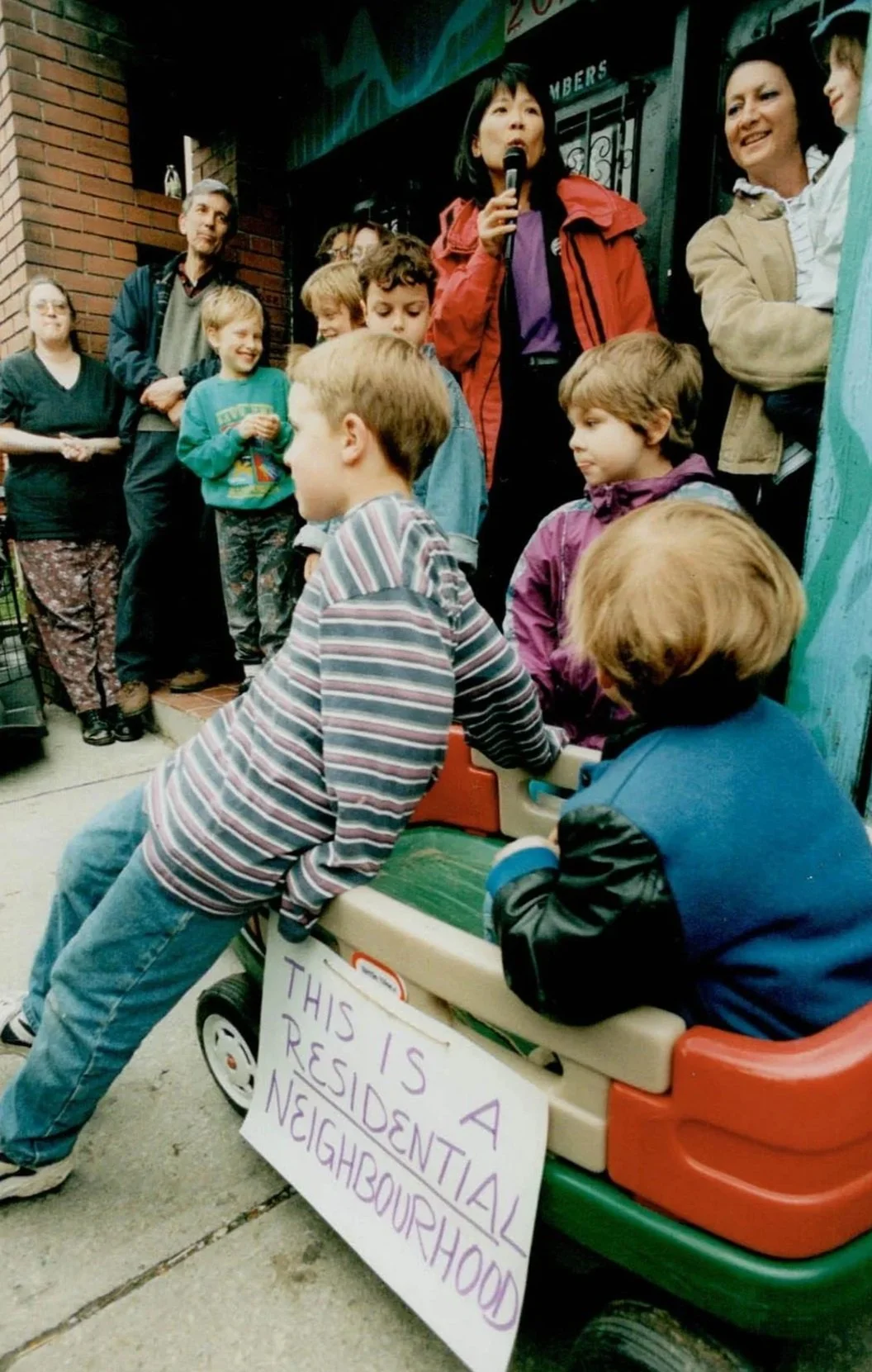
Olivia Chow, 1997 (copyright Toronto Star)
Before becoming Mayor of Toronto, Olivia Chow talked about how she got involved with bicycle advocacy, and why it won’t work without trust.
“I came to Canada when I was 13, in 1970. I learned how to ride my bike at Centre Island, and I haven't stopped.”
I'm a year-round cyclist. I have a bike shed with five bikes and no car. I have three parking spots in the back, but they just sit empty.
Because I've ridden for so long, I was always comfortable in the lane, on the road. I noticed that I was usually the only one on the road in winter. But not necessarily in the summer!
I was doored three times - all the injuries I've had are being doored by cars. One time someone opened a door on the parking side, the right side, which is to be expected, except we were at an intersection! All of a sudden, the car stopped and someone opened the door on the right side.
So I'm always looking on that side too. I can anticipate. I haven't been doored since I was in my twenties. Touch wood.
In the late eighties, I was a school board trustee, and Jack Layton was the city council representative on the Board of Health. We were both year-round cyclists for transport. Neither of us had a car. Our wedding present for each other was a tandem. That's how much we were into bicycles.
We had two kids, and we would have cycling holidays with the kids. We would take a tandem - very important. We would pack all the gear behind us and go camping in Manitoulin Island, Les Îles-de-la-Madeleine, and PEI. So cycling was part of our lives.
“There weren't really any bike lanes in the eighties.”
When we went on holidays, whether it was Amsterdam or Quebec and Montreal, we saw these bike lanes and thought, wow this is amazing.
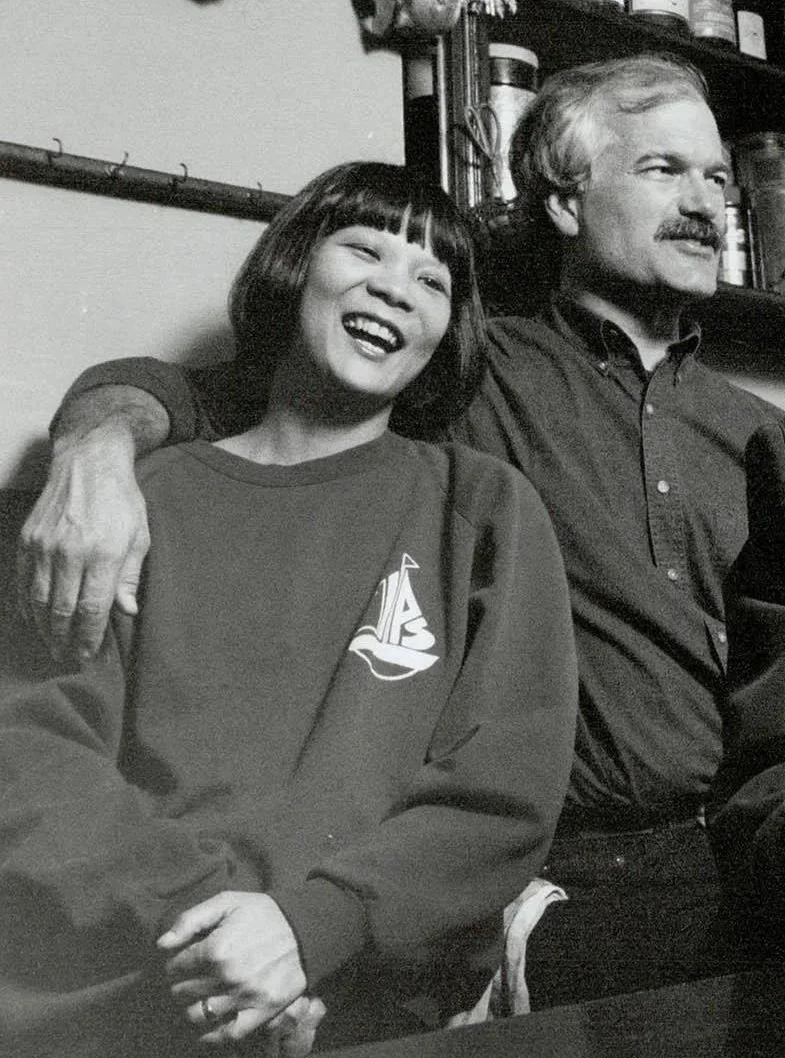
Olivia Chow and Jack Layton, 1994 (copyright Toronto Star)
Jack started the Toronto Cycling Committee, and when I became a metro councillor [ed: following the amalgamation of Toronto and neighbouring municipalities in 1997], I started the Metro Cycling Committee. Because it shouldn't be just the City of Toronto.
I believe the first battle was the bike lane on Beverley Street, and St. George. We got it. Then it became College Street, and then it grew, and there were more and more bike lanes.
It wasn't just the bike lane, it's how the bike lane is designed, bike parking - all those things. So it was constant battling.
I remember getting a bike lane because there was a death. It needs to be emotional in some ways, you have to get people to say, "You know, because we are not creating a bike lane, or safe cycling, people are dying." And then all of a sudden, people go "oh yeah, I guess".
Activism can be emotional, whereas some make the contrast that advocacy is about shared problems, and relationship building - not me against you.
“Do you see that they're two different things?”
You need to build relationships in order to get anything done - you build relationships with like-minded people in order to get the power you need to make the change you want.
But you also need to say to the store-owners, “you know what, if you lose some parking, it will not be the end of the world, because all the cyclists are going to shop. They don’t just go by.”
They have to trust you. We didn't actually lose parking on College Street. When Jack did the Danforth, because that was his riding, he expanded the sidewalk, and people just went "oh my god". It turned out that because of the wider sidewalk and the reconfiguration, the Danforth became very trendy. Then Greektown and the Taste of Danforth all happened.
So you have to build enough relationships with people you're trying to sell the concept to, so they trust you, they know you're not out to mess up their business.
“But ultimately the most important thing is asking the question, ‘what do they want that you can give them?’”
We're saying to the cyclists - look, these people want business. So when you go and frequent your favourite shops in the area, say, “hey I'm a cyclist, I'm here buying. Having a bike lane will not be the end of the world.” Then they say, “oh, okay—my customers are cyclists or pedestrians. I want their business! It's not the end if I don't have the parking spot right in front of my store.”
You can do all the studies, there's reams of research—there's no end to it. But that doesn’t move people's hearts and minds. The key thing is reaching out on the grass root level to the people that live in the area.
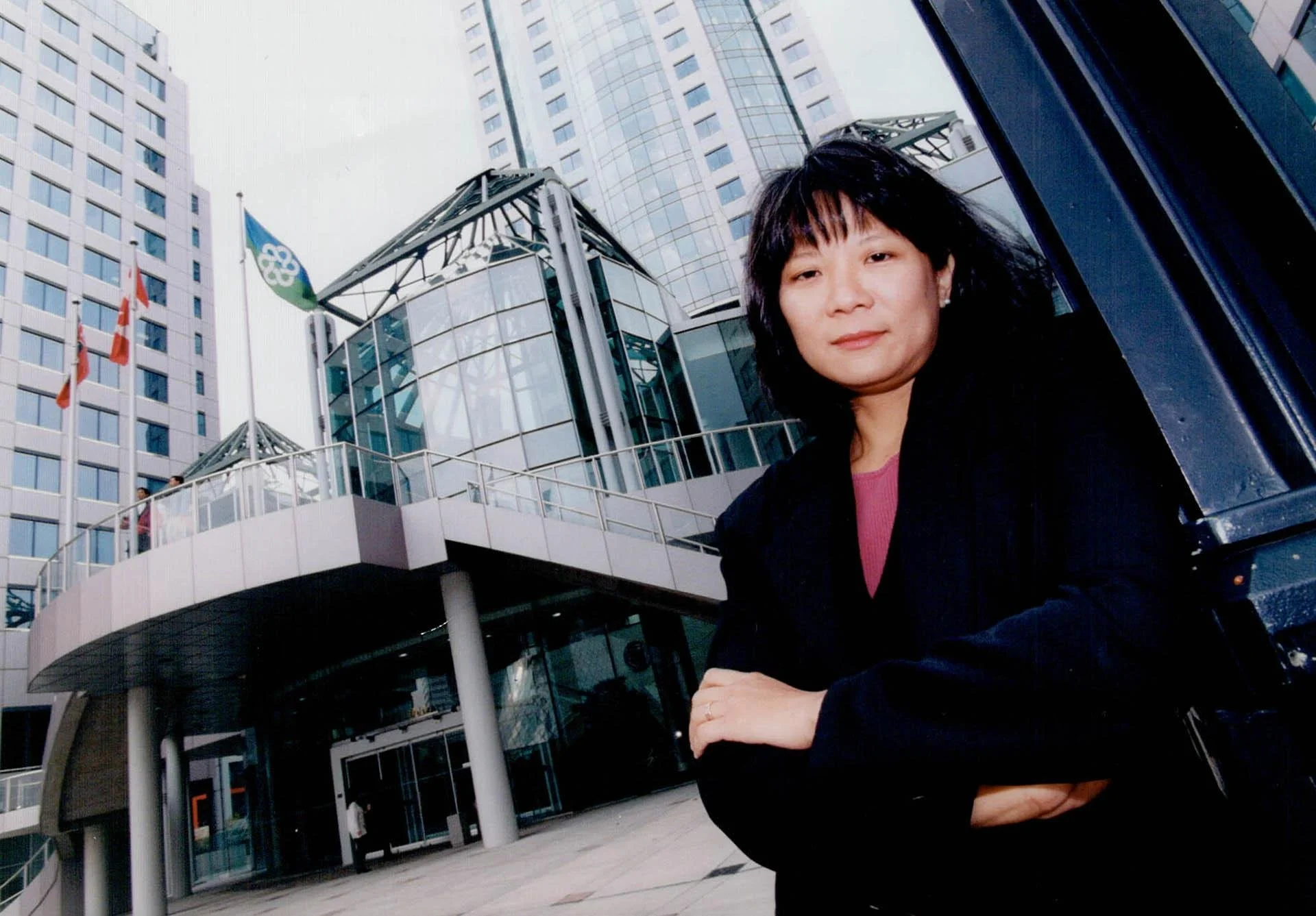
Olivia Chow, 1996 (copyright Toronto Star)
“We also encouraged a cycling culture.”
There was a bike to work week, there was a bike choir, a bike fashion show, a best-looking helmet design contest, auctions. And we did fun things, like “let's have a race.” We were on three modes - TTC, driving, and cycling. Jack and I were on a tandem, another councillor was on a streetcar, another was driving. We did that in the nineties, to get people to think, "oh cycling could be faster".
Like with getting a bike lane on Bloor—that took twenty years, good god. We finally got it, but back in the days we tried to prove you can be faster on a bike than driving on Bloor. Of course we got there first.
I became a member of parliament, and I was Transport critic for the NDP. That was in 2012. There was no national cycling strategy. So I put in a motion. It's not that well known. In it was all the resources—infrastructure, all the key elements you would expect in a national cycling strategy.
“Infrastructure funding is billions of dollars.”
One of the requests on that motion was that if it's 2% of Canadians riding a bicycle, 2% of the national infrastructure funds should be dedicated to cycling. If it is 3% of Canadians riding a bike, then it should be 3% of the infrastructure funds, right?
There really is no national cycling funding resources from the federal government. So I was trying to build some momentum around that request, so that when there's a national budget coming up, one should begin that dialogue to say, “hey, all the infrastructure is fine, but a lot of the infrastructure is for transit and roads. What about cycling?” Cycling infrastructure funding is really not very much, but still it would be helpful.
When Vancouver hosted Velo City in 2012, I used that occasion to start up the national cycling committee. And there was a founding meeting - I was an MP so I was quarterbacking the organizing of it for about six months. I don't know what happened to it.
Well, because those guys were all about structure. Sorry to make it gender-based, but they need more women on it. I was saying, “we need to build relationships with groups that have very wide reach, and you need to do things that are popular among different cities!” I started the damn thing, but I wasn’t even in the database! I was a politician then, so I couldn't say anything. But I was also an organizer, a political organizer by nature. So I looked at it and thought - be careful guys! I shouldn't be so negative.
Velo Quebec did a presentation that - wow, the money, the tourism, they are professional. I thought “ooooh”. And they have political muscles, going after Marc Garneau and to have Montreal as a huge cycling place.
So you need a team on the national side to think about linking to all the powerful movement groups that are on cycling, and really coordinate it and have a discussion, and conference call, to say, “okay what is our priority for this year?” And for five years—”how are we going to get there? How are we going to reach? We need 100,000 members across the country within two years - how are we going to get there?” They need to set those targets and think of strategy that could really organize themselves in a way that can bring that into a reality.
“Immediately, the feds could tell the trucking companies they need to have truck side guards.”
God, how many more deaths do you want? All the European countries - 60% decrease in deaths when side guards are installed. They've had that for twenty years. If you look at all the trucks that are from Europe, if you want to buy trucks from Europe, they all have side guards. It won't slow you down, in fact, it's aerodynamic! It will save fuel! Relax guys. But it will cost money.
Some trucking companies said, "if you pay for it, we'll do it." Well, hey maybe the federal government can do a pilot project, an initiative - the first hundred trucks, we'll pay for it, or whatever. It will cost them .001%. Side guards are really cheap. In fact, I talked to one company into doing it. I think you can go down to $900 per truck, a few years ago it was $600-$900. We had a press conference with a trucking company that voluntarily put side guards on their trucks. It was a no-brainer.
There are some municipalities that are already doing it. There was a death in the maritimes, and the municipality said, "we'll just install them." It would be good for Vancouver—start with the city trucks first. You lead by example, and then people say "oh okay". Because my god, every time I'm out in the street, I see a truck making a right turn, and a cyclist going - I actually reach out and grab them - "don't go there...because if they make a right turn, they get into the gap, you're toast." A lot of cyclists don't realize that gap can be really dangerous.
“A lot of it is who are you communicating with.”
It's not the issue, it's who are you bringing together. And the messaging. But it's really the 'who' that starts first. Who you are organizing. Before you even think about who you're trying to influence, you need to define who you're bringing together.
Advocacy should be defined as bringing people together to get the power, and the change they want. How are you bringing the people together?
Advocacy is not just me, the smart person, the advocate telling you what I need. No. A leader—a political leader—is really enabling others to achieve purpose in times of uncertainty.
You don't know if you'll win whatever you're pushing for. You never know what the results are going to be. The Bloor bike lane was very uncertain for many years. But enabling people to achieve purpose when they have every year, they have a Cycle on Bloor, they bring people out, they have a picnic afterwards at Queen's Park.
The linkage is often not there. So you have to enable people.
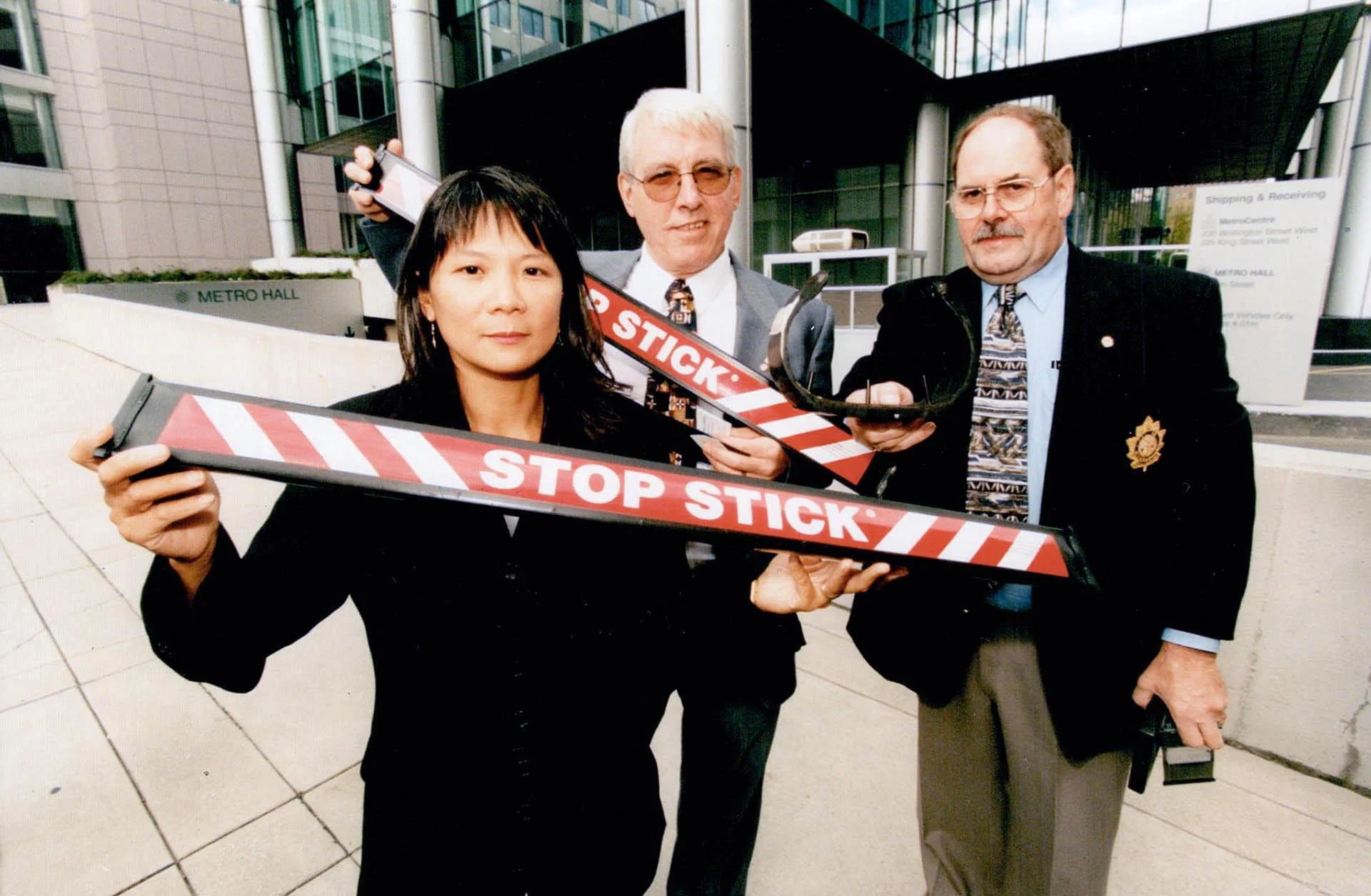
Olivia Chow and road safety collaborators Don Watch and Fred Johns, 1998 (copyright Toronto Star)
Advocates say, “I tell you what I want because I'm smart and I know how to meet with the minister. I'm the gatekeeper, I'm the smart one.” But you can go and hire Earnscliffe. [ed: Earnscliffe Strategies, an Ottawa-based public affairs firm] You can hire a lobbyist, a GR firm, and get it done. Those are advocates. That's not good political organizing per se. They’re not necessarily good leaders.
Organizing is different from advocacy. Organizing, you bring people together to make a change.
“Power and change only comes when you do political organizing.”
It’s much more difficult, because you then have to involve many more people. You have to enable them, make sure they achieve purpose.
If you think about all the wins, whether it is in Vancouver or Toronto, the win came when there is a large group of people saying, “hang on! This is what we need. You need our vote. We will support you if.”
Right? If you don't flex those political muscles, you can give them all the arguments you want, all the research you want - not going to happen.
From an interview with Olivia Chow on May 25, 2017 at her home in downtown Toronto.